Knowledge / COMPARISON
Steel or masonry construction?
We build in steel — and still, masonry is sometimes the better choice. The comparison in seven points, without the usual sales omissions.
4 min read
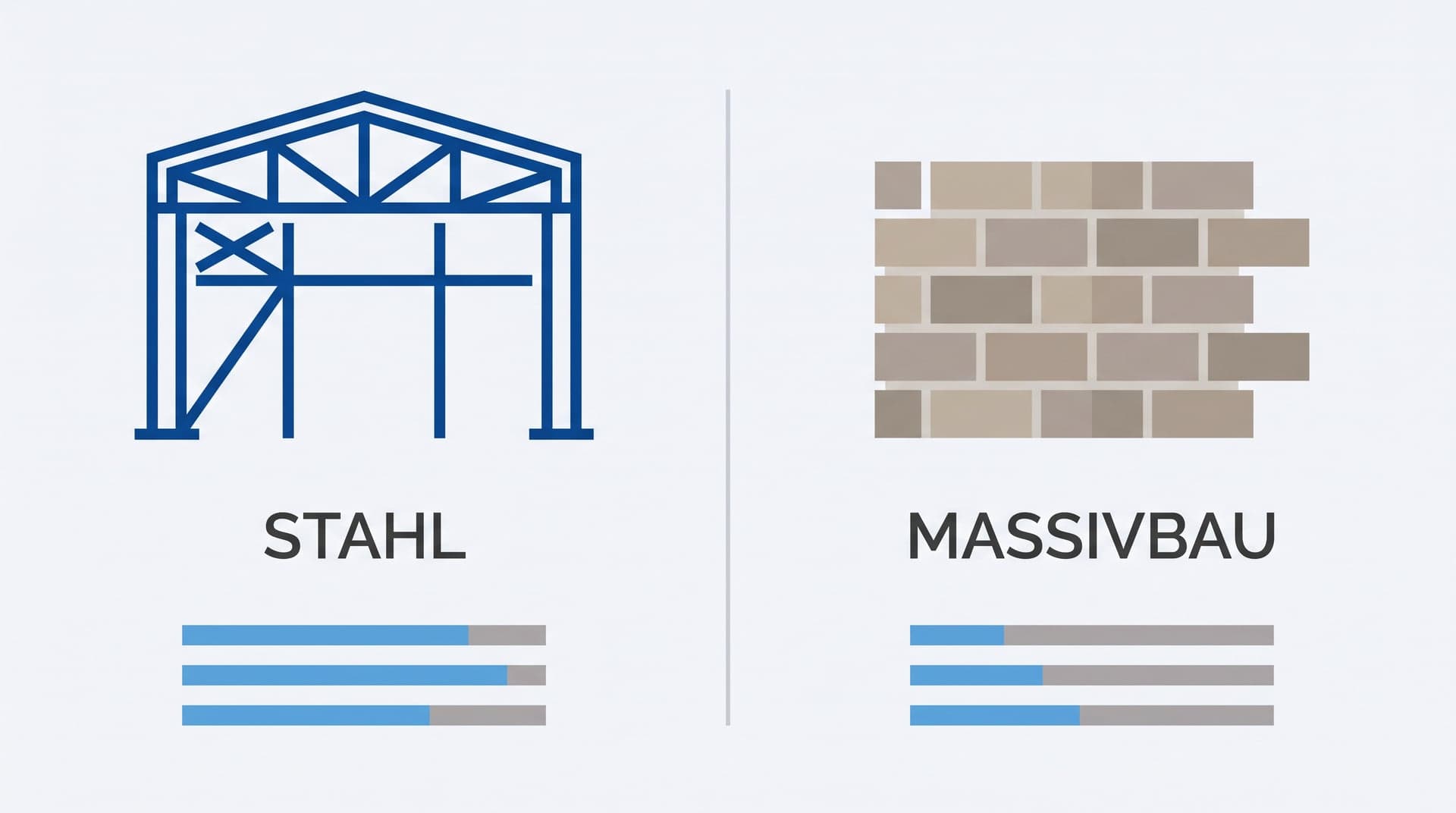
Construction time: the clearest point for steel
In steel construction the frame is fabricated in the workshop while the foundations are built on site — two work stages run in parallel. On site, components are bolted rather than cast: no formwork, no curing times, far less dependence on the weather. Masonry, by contrast, rises course by course on site, and concrete needs time before it carries load. To be fair: the head start concerns the structural shell. Permits, floor slab and interior fit-out take similarly long in both methods. If you need the hall quickly, steel is almost always the better choice — but it does not work miracles either.
Spans and flexibility: steel's home ground
Large column-free floors are the core territory of steel construction. Where masonry needs heavy downstand beams or extra column rows for wide spans, a steel frame bridges the same area with slender trusses — more usable floor, unobstructed logistics routes, flexible machine layouts. Later openings, new gates or an additional bay can be engineered predictably, because the frame remains calculable. For small rooms without any span requirement — offices, staff rooms, small workshops — this advantage counts for little: there, a masonry wall carries just as well and is often more economical.
Cost: different profiles, no universal winner
Blanket claims like "steel is cheaper" are, in our view, not serious — it depends on the building. The cost profiles differ: in steel construction, a large share of the cost sits in the prefabricated frame; the larger the floor and the span, the more prefabrication pays off. The shorter construction period also cuts financing and downtime costs — an item price comparisons like to ignore. In masonry, material is often cheaper, but more labour and more time are spent on site. A rule of thumb, used with care: the larger and more column-free the building, the more steel pays; the smaller and more compartmentalised, the more masonry does.
Fire protection: masonry is ahead here
This belongs in an honest comparison: steel does not burn, but it loses load-bearing capacity at high temperatures. Wherever fire regulations demand a defined fire-resistance period for the structure, steel therefore needs protective measures — intumescent coating, cladding, or compensation through systems such as sprinklers. That costs money and must be planned in from the start. Concrete and masonry largely bring their fire resistance with them. For many single-storey halls the structural requirements are moderate and this point decides nothing. Under strict requirements, however, it belongs on the table — from day one, not as a surprise during permitting.
Insulation and building physics: two systems, two logics
In a steel hall it is not the steel that insulates but the envelope: sandwich panels and insulation packages achieve very good values at low weight, and the performance can be tailored precisely to the use. Masonry brings something steel inherently lacks: thermal mass. Heavy walls buffer temperature swings and sound — a genuine advantage for occupied rooms, offices and noise-sensitive settings. In practice, many projects therefore combine both: a steel frame for the hall, massive construction for the office and staff wing. That is not a compromise but each material's strength in the right place.
Conversion and extension: steel stays changeable
Businesses change — their halls should be able to follow. A bolted steel frame can be extended, strengthened and reconfigured: additional bays along the existing grid, reinforced columns for a future crane runway, new openings in the façade. The precondition is a structural design with reserves from the start. In masonry, interventions in the structure are more demanding: walls carry load, openings need support structures, extensions need their own foundations and clean junctions. Not impossible — but slower and more expensive. If you already know your operation will grow, steel gives you the more flexible starting position.
Resale and recycling: the building's second life
Steel is fully recyclable without loss of quality — structural steel is among the most consistently recycled materials there are. A steel frame can be dismantled, relocated or sold as raw material; at the end of its use it retains real residual value. Demolition concrete, by contrast, is mostly crushed into fill. For resale as a building, something else matters: a flexible, column-free hall suits many subsequent users and is correspondingly easier to let. A massive building, in turn, can command higher regard for prestige uses. If you think long-term, know both perspectives — material value and re-usability.
INQUIRY / NO OBLIGATION
Your project in steel?
A direct line to management — answer within 24 hours.